About honest materials, imitations, and the silent longing for authenticity
The aesthetics of Severance and what it triggers in me
The series Severance on Apple TV+ not only tells a dystopian story about the divided self—it also depicts a world that deeply moves me aesthetically. Clean lines, coordinated shades of green, wood paneling, simple textures: all of this creates an atmosphere of order and tranquility, but also alienation. It is an artificial world—and that is precisely what makes it so fascinating.
My interest in this aesthetic – and in the 1970s, cassette futurism, and mid-century design in general – is not retro fetishism. For me, it’s about something deeper: the way materials were used back then. How form and function belonged together. How things still meant what they said.
The 60s-70s: When materials still had attitude
For me, the 1960s to the 1970s represent a design attitude in which new materials such as plastic or glass-fiber reinforced plastic were not used to imitate other materials, but to enable something new. Eero Aarnio’s Ball Chair would have been unthinkable without these materials. This was not a break with style, but a design consequence: the material determined the form.


At the same time, strong influences from functional modernism were still evident during this period – in particular the legacy of the Bauhaus and the Ulm School of Design. Designers such as Dieter Rams embodied an ethic of product design that placed form and function in an honest relationship. Rams’ principles, such as “Good design is as little design as possible” and “Good design is honest”, became benchmarks.
Even companies such as Apple drew on this way of thinking in their early years. Devices such as the Apple II and the first Macintosh were not only functionally well-thought-out, but also reduced in form – with clean lines, subtle colors, and a design language clearly reminiscent of Braun designs from the 1960s and 1970s. Here, too, there was no imitation, but rather an independent design inspired by the spirit of the material.
This clarity appeals to me. Not because I romanticize everything old, but because I feel that today we have too often forgotten what things actually are.
When plastic pretends to be wood
I have a personal aversion to wood-effect plastic. Not because I reject plastic outright, but because in this case it pretends to be something it is not. It does not look like wood—it looks like an attempt to imitate wood. The result is neither honest nor beautiful. It is smooth, but lacks depth. Durable, but without dignity.
For me, it’s less about the individual object than the principle: when we start hiding or disguising materials, we lose trust in what things could actually mean.
Artificial plants: the silent symbol of a great displacement
For me, plastic plants are an even clearer example of this development. They symbolize the attempt to replace life with something completely dead. A real plant produces oxygen, regulates the indoor climate, changes, lives. An artificial plant, on the other hand, is made of petrochemical-based plastic, can release microplastics, is CO₂-intensive to manufacture—and eventually becomes problematic waste.
And yet there it stands, in many homes. As a reassuring sign: “There is life here.” But it is a false life. A gesture of repression.
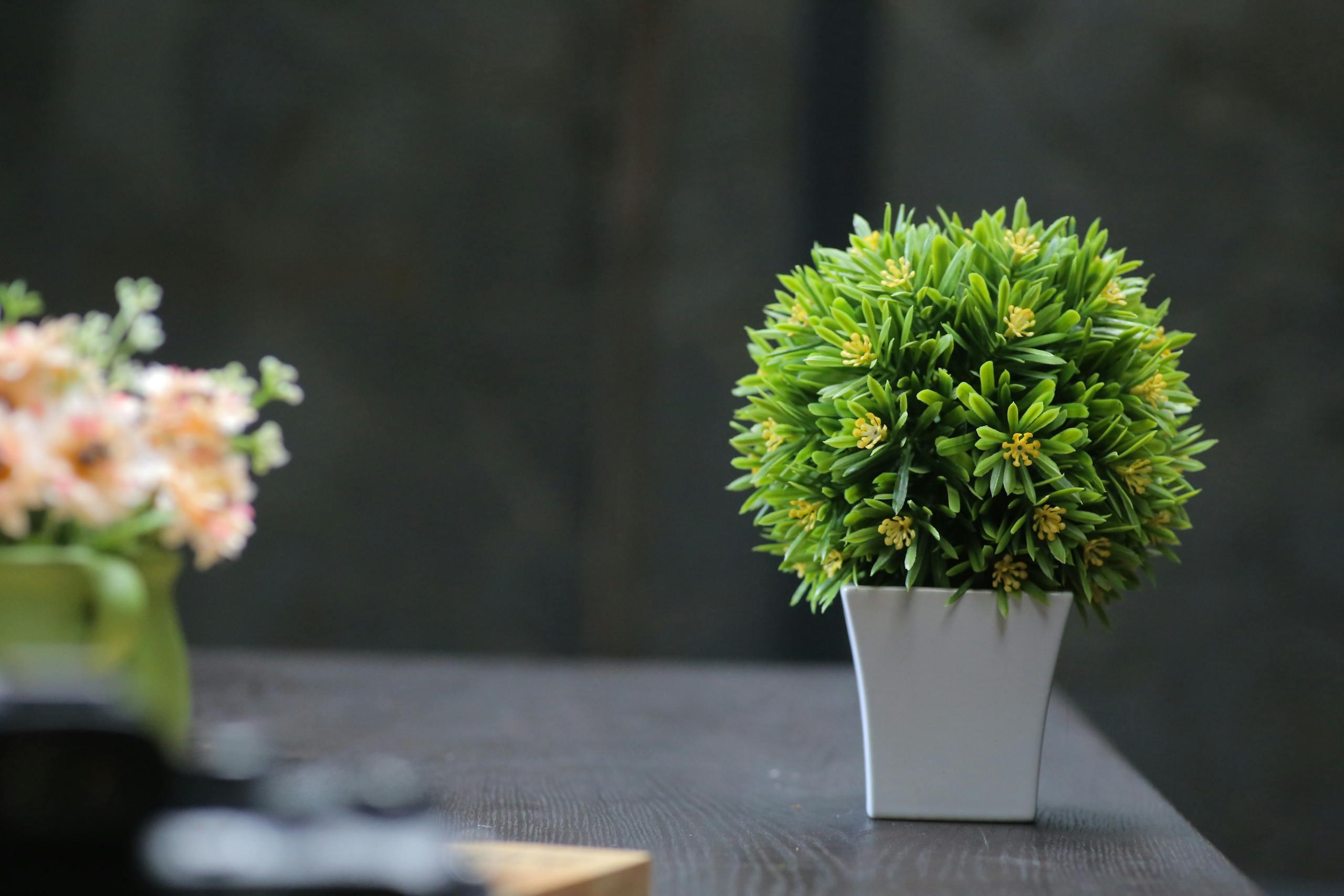
This logic is not new – it can also be seen in fast fashion, disposable furniture, and cheap decorations. The main thing is that it looks good somehow. For now. For the eye. For the illusion.
I understand that people are under pressure – time pressure, financial pressure, mental pressure. No one makes these decisions out of malice. But we should recognize that these small compromises change our relationship with the world. When we start replacing life with imitation because caring for things is too much effort, we may lose more than just a little atmosphere – we lose our willingness to form relationships with things.
This is not dogma. It is not a call for asceticism. It is a desire for awareness. A desire to let the uncomfortable, the high-maintenance, the real back into our spaces.
Between IKEA and ideals
I don’t believe that all furniture has to be made of solid wood – I myself own furniture from IKEA. It’s a value proposition that’s hard to beat: a simple cabinet may not have the quality of handmade carpentry, but it may fulfill 80% of the same function for 20% of the price. That’s the Pareto principle in its purest form.
And yet, the question remains: what does this simplification cost us in the long run? Even if the price is right, the total cost of ownership is often higher – when things age faster, fall apart or need to be replaced. Even more significant is the cultural price: we are getting used to replacing things rather than maintaining them. We are losing the ability to think in terms of long-term relationships with objects.
“Honest” furniture, clothing, yes: an honest life – that’s expensive. Or at least: not easy. It takes time, care, responsibility. And no – things weren’t better in the past. The iconic images from design magazines of the 1970s show the homes of wealthy people. The design aesthetic of that era was never mainstream.
But should we celebrate the fact that today everyone can afford something beautiful – even if it may not last long? Isn’t commodification also a form of democratization?
Perhaps. And yet I stand by my position: plastic has its place when it is used honestly. But too often it is used as a substitute, not as a material with its own expression. Too often it becomes a short-term solution that takes more than it gives in the long run.
What I want is not an elitist world of handmade products, but a new appreciation for the durable, the maintainable, the honest.
Between deception and transformation: dialectical honesty
Not every instance of “material deception” is negative—sometimes it is downright poetic. There is a form of honest dishonesty that I deeply appreciate: when an object reveals that it is deceiving—and it is precisely in this that it shows its mastery.
A prime example for me is the classic marble statue: it does not pretend to be real skin or real fabric – and yet it suggests it with such technical and artistic precision that the material takes on a new level of meaning. The fabric appears soft, the skin alive – even though the marble is cool and hard.


Probably the most impressive example is The Veiled Virgin (Giovanni Strazza, 19th century). The veil, finely carved from a single block of marble, appears translucent, delicate, and lifelike—and impressively demonstrates what material art is capable of.
Such objects transform material not into deception, but into a tribute to its versatility. What they all have in common is that they do not seek to hide what they are – but rather to show what a material is capable of when encountered on equal terms.
Here, deception is not a betrayal, but a compliment.
A personal plea
I don’t want a perfect world. I want a real one.
One where not everything is flawless – but where many things are meaningful. One where we live with things instead of just using them. One where materials are allowed to tell their story.
Perhaps this is about more than just furniture or plants. Perhaps it’s about our attitude toward aging, toward imperfection, toward dignity. We should learn that flaws are not a disgrace – neither in things nor in people. That signs of wear tell stories. That patina is a sign of life.
This applies not only to wooden tables, but also to faces, relationships, and life stories. An honest life is rarely flawless—but perhaps that is precisely its strength.
And maybe none of this is a design philosophy. Maybe it’s just a wish:
That our surroundings don’t just please us — that they mean something to us.


